
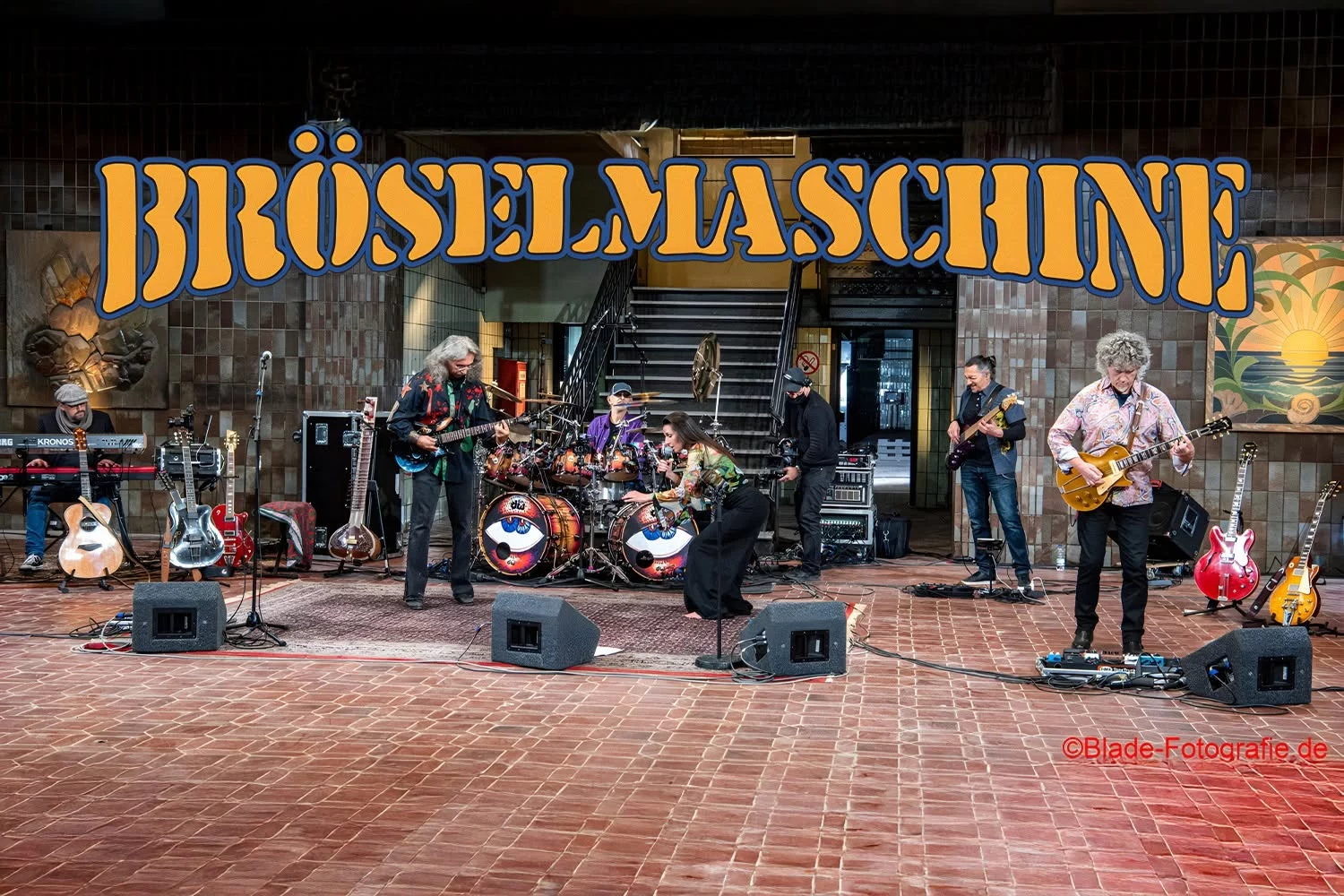
BRÖSELMASCHINE
We started out at a time of great upheaval. We didn’t want to turn out like our parents; we wanted to experiment with new ways of living and, naturally, set no limits on our music.
We had already been playing in various bands in Duisburg and, in the autumn of 1968, came up with the idea of moving into a large shared apartment—a commune—where we could try out whatever we wanted. We were fortunate enough to meet Rolf-Ulrich Kaiser shortly beforehand at the *Essener Songtage*—Germany’s first major rock and folk festival—where he spontaneously offered us a recording contract. At the time, he was one of the key figures championing the nascent German rock scene.
Back then, there were no promoters or agencies for a German band playing such unconventional music. We had to figure everything out for ourselves, gaining plenty of experience—both positive and negative—along the way. British and American observers later dubbed this sound “Krautrock,” owing to its German origins and distinctive style. Since then, the band has toured across Europe and the USA, released numerous albums, DVDs, and live recordings, performed live on television (including WDR’s *Rockpalast* and the *Aufruhr* Festival), opened the Duisburg Easter March for many years, helped found the renowned *Eschhaus* youth center, and shared the stage with internationally acclaimed bands at numerous festivals. In doing so, Bröselmaschine has played a pivotal role in shaping the cultural landscape of Duisburg.
To mark the band’s 50th anniversary, an exhibition tracing the history of this Duisburg group was held at the Cubus Kunsthalle in Duisburg from August to September 2018, featuring photographic and film documentation alongside the band’s instruments. Concurrently, Bröselmaschine performed live at various events, including the Lehmbruck Museum’s summer festival on August 26, the open-air stage in Mülheim on August 29, and the *Werner-Rennen* in Schleswig-Holstein on September 1 (an event drawing over 100,000 festival-goers).
Bröselmaschine is one of Germany’s most enduring and influential Krautrock and folk-rock bands. Founded in Duisburg in 1968 by master guitarist Peter Bursch and artist Willi Kissmer, the band is famous for its unique blend of progressive rock, psychedelia, traditional folk, and Indian classical music.