

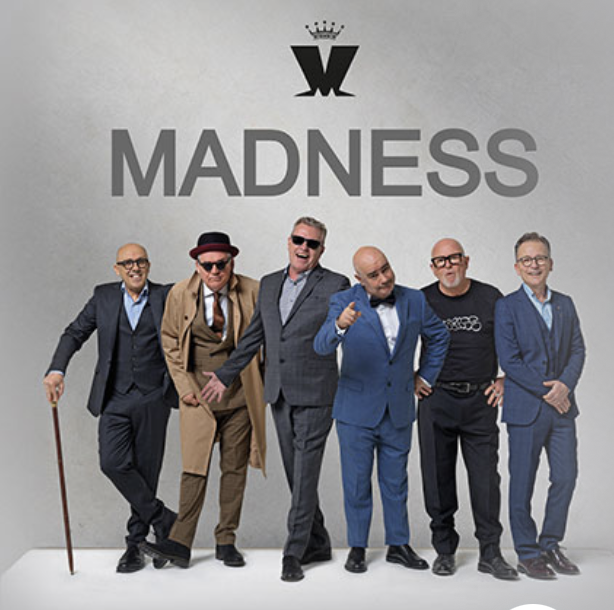
MADNESS at Kunst!Rasen 2026
With a sound rooted in ska, but also showing the influence of classic British pop, Madness have enjoyed a long career full of hit singles, influential albums, and satisfied concert audiences. They were known initially for blending ska rhythms with catchy melodies and a nutty sense of humor on their 1979 debut album One Step Beyond, one of the seminal works of the 2-Tone era. As their career progressed, they folded touches of Motown, soul, and on 1982’s Madness Presents the Rise & Fall, British pop, into their formula. A single from that album, the jaunty, Kinks-influenced “Our House” rose to the upper reaches of numerous singles charts around the globe and became an enduring classic. 2009’s The Liberty of Norton Folgate was a reunion effort as pleasing as their classic ’80s releases, and Madness showed no signs of slowing down, touring the world and launching new projects such as 2018’s Can’t Touch Us Now and 2023’s The Theatre of the Absurd Introduces C’est La Vie.
The origins of Madness lie in a ska group known as the Invaders, which was formed by Mike Barson, Chris Foreman, and Lee Thompson in 1976. By 1978, the band had changed their name to Morris and the Minors and had added Graham “Suggs” McPherson, Mark Bedford, Chas Sash, and Dan Woodgate to the group. Later in 1978, they changed their name to Madness, in homage to one of their favorite Prince Buster songs. The following year, Madness released their debut single, a tribute to Prince Buster entitled “The Prince,” on Two-Tone. The song was a surprise hit, reaching the British Top 20. Following its success, the band signed a record contract with Stiff Records and released another Prince Busternumber, “One Step Beyond,” which climbed to number seven.
Madness returned in the late summer of 1982 with The Rise and Fall, their full-fledged shift to pop. Like their previous albums, it was a British hit, reaching the Top Ten, but it also contained the seeds of their brief American success with the Top Five British single “Our House.” The single was released in America on the group’s new label, Geffen, and it received heavy airplay from MTV. The music video network had previously aired the videos for “House of Fun,” “It Must Be Love,” and “Cardiac Arrest” while the band’s albums were unreleased in the United States, thereby setting the stage for “Our House” to become a massive hit. With “Our House,” Madness had MTV exposure that coincided with a record release for the first time, the U.S. compilation album Madness, which sent the single into the American Top Ten in the summer of 1983; the album topped out at number 41. Madness managed one more American Top 40 hit that fall, when “It Must Be Love” peaked at number 33.
At the end of 1983, Mike Barson, the band’s key songwriter, left the group to settle down with his wife. Although Madness was able to stay near the top of the charts with their first post-Barson release, “Michael Caine,” the band’s fortunes began to decline over the course of 1984. Upon its release in the spring, Keep Moving hit number six on the British charts; in America, the record reached number 109. In June, the group released its final single for Stiff Records, “One Better Day,” which peaked at number 17. A few months later, Madness formed their own record label, Zarjazz; their first release, “Yesterday’s Men,” came out in September of 1985, nearly a year after the label’s formation. The record peaked at number 18 and its parent album, Mad Not Mad, reached number 16 upon its October release. Their chart decline continued early in 1986, when their cover of Scritti Politti’s “Sweetest Girl” peaked at number 35. Madness were quiet in 1986 until September, when they announced they were disbanding. Two months later, their farewell single, “Waiting for the Ghost Train,” was released, charting at number 18.
After remaining dormant for a year-and-a-half, the group reunited at the beginning of 1988 as a quartet called the Madness, releasing its comeback single, “I Pronounce You,” in March.
In the summer of 1992, the original lineup of Madness reunited to perform two outdoor concerts at London’s Finsbury Park. The group dubbed the event Madstock and released a recording of the shows on Go! Records. Madstock became an annual event for the next four years — every summer the band would reunite and headline an outdoor festival at Finsbury Park.
In 2011, Madness launched the annual “House of Fun Weekender,” a three-day festival curated by the band in which they performed alongside a wealth of like-minded artists. During 2012, the band took part in high-profile performances that celebrated the best of British culture. They played from the top of Buckingham Palace at the Queen’s Diamond Jubilee party and appeared in the closing ceremony of the London Olympic Games.
In 2022, they made the show and its soundtrack available in physical media format. In 2023, Madness treated their fans with a new studio album, The Theatre of the Absurd Introduces C’est La Vie. It marked the first time the group produced themselves, with engineer Matt Galsbey recording and mixing the material.